This is a mirror of a post meant for SGRiichi. You may find that post here.
Last June, SGRiichi got invited to join Asian City Riichi Championship 2026. I got very fortunate and managed to get selected to be one of the four players from Singapore to take part in this event.
This tournament took place at Mah-Jestic, a Hong Kong mahjong parlour. I’ve previously been to this mahjong parlour, and it is a very enjoyable place to play at. It had REXX III autotables, as well as very good overhead lighting to ensure that the tiles are easily visible. Despite not speaking Cantonese, the staff was very welcoming. Moreover, the venue was non-smoking and didn’t smell of smoke. When I went there a few months back, I had an enjoyable time as even on weekday afternoon, there were a handful of players to play with. I do recommend if you’re in Hong Kong to check it out, though as with most things in Hong Kong, it is unassuming at ground level, and require you to take a small lift up to its floor.
In ACRC, they had invited 60 players to play, on 15 autotables (though not all REXX III). With such an event, the player base was competent and there weren’t any casual players. There were also many Chinese Saikouisen pros in the event. As I personally am strongly considering for applying for the WRPM pro exam, it was interesting to interact and gain an deeper appreciation what signing up for a pro might entail.
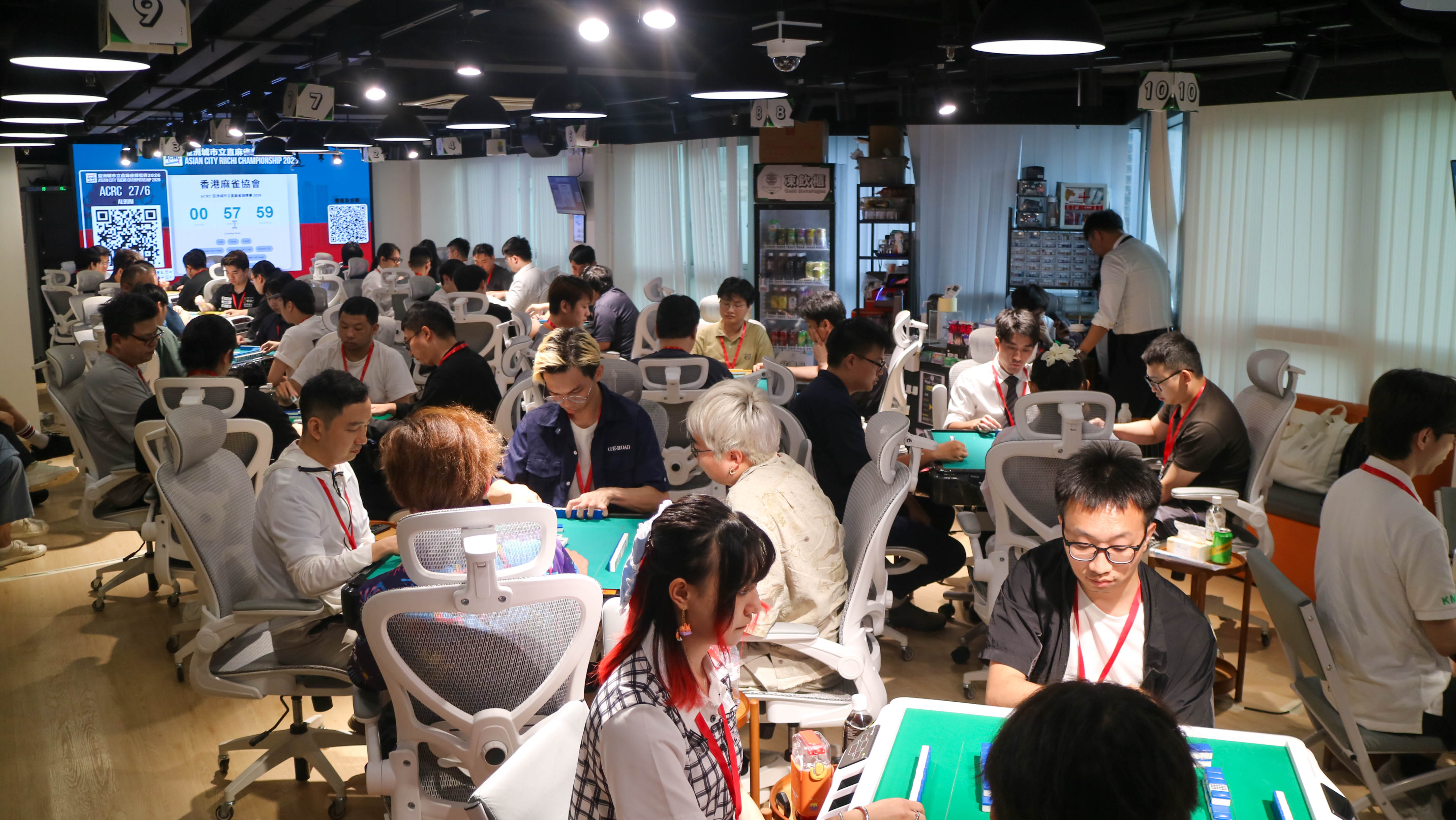
Mah-Jestic, location of the competition, Day 1 Game 5 pictured
The riichi community isn’t a big one. Personally, I was surprised to run into Kiing, which I previously played alongside in World Riichi Online Team League 2025. We previously only met over discord, so converting an online acquaintance into an offline friend was a serendipitous happenstance. Mahjong requires three other people to play, so the social aspects of the game shouldn’t be entirely neglected. I’m very fortunate to have met many new friends in this trip.
Personal Preparation
There is a sense of imposter syndrome personally going into the competition. I am neither a particularly strong player, nor am I a veteran with many years of experience. Indeed, I mainly play online, and only started to take mahjong seriously in the last year or so. Here are some things I did in preparation.
-
One thing I noticed from my previous tournaments was that even a day long tournament was physically draining. I normally only play in 2-3 hour blocks at night. As such, in the weeks leading up to the event, I made myself play long 7-8 hour days on the weekends. This is the main success I personally achieved at this event, as together with proper sleep management, I didn’t feel tired at all in this weekend.
-
Tile Handling. If you’re an online player, there are two major things to ensure:
- When drawing a tile, ensure the tile is not revealed to your shimocha (or kamicha if you’re left-handed);
- When pushing the walls and hands forward, don’t topple them.
Thus, I attempted to do all these actions deliberately and slowly. There were, unfortunately, still things that caught me by surprise. By not being conscious that it was an error I could make, in one of my games, as oya, I drew 15 tiles at my haipai. This is often a chombo, but in this tournament, I was only given a dead hand penalty.
-
Scoring. Playing online, you develop a skill for scoring the “wrong” way. For instance, you can quickly know that a score gap of 5500 as non-oya can be surmounted via a 3900 direct hit, 1300-2600 tsumo, or 1000-2000 tsumo against oya. Thus, its easy to score for gyakuten conditions or determine the value of your own hand. The tricky thing personally is when you have an extra han you didn’t expect, as you need to recount your score again. As a compromise, I used the following method:
- Determine the value of your hand for tsumo and ron.
- Watch for your winning tile. (In previous practice, I managed to miss an ippatsu ron before as I was too busy scoring.)
- On winning, run through the checklist: ippatsu, ura dora, tsumo/ron on dora, and takame yaku.
By systematically working through it, I may be slower at scoring, but I won’t make any mistakes. Fortunately, this was the most trainable skill, and I didn’t face any issues.
-
Personally, etiquette is a very important aspect of competing. Although etiquette are not rules, it still necessary to show respect to the game and your fellow players. Here, especially, wearing the Singaporean banner, it is all the more important to showcase good sportsmanship. Fortunately, this was the easiest step, as one can just read and follow the SGRiichi guidelines.
Though not all factors may be applicable to you, I hope that this inspires some readers into physical/offline tournament play.
Tournament Format
We played 8 rounds round-robin over 2 days, 6 in the first and 2 in the second. On the day before the tournament, when we went to register, not only the tables have been predetermined, but which seat we will be playing as well. I think this is very beneficial to ensure rounds can proceed smoothly, as seat selection can have variants. Moreover, all participants should be present at seat selection to ensure fairness, by avoiding it, even if a participant runs late, you can minimise this added time. Another notable thing of this seat allocation is that in these 8 rounds, I was given 2 Easts, 2 Souths, 2 Wests and 2 Norths. I am unsure if they manage to allocate this way to all players, but it does mitigate the seat biases.
The rules will be familiar to M-League enjoyers, with 3 red fives and (effectively) an uma of 45/5/-15/-35. This score is accumulated over 8 rounds, while the top 24 will go on to play the semifinals with their score halved. Then, combining this halved score with the results in the semifinals, the top 4 will go on to play the finals with their semifinal totals halved. The final combination determines the placement for the top 4.
Personally, I’m still internalising what the changes in uma means. Many key decisions in South 3 and South 4 comes down to a deeper understanding of different uma and how one should approach the game. It is always unclear in mahjong whether performing poorly comes down to luck or just not understanding strategy. This point and score awareness I’m still lacking, and would be what I will work on in the coming months.
Another aspect of tournament play is the time limit. One always have to be aware about the time limit, as an initial North seat might not get their oya turn before the end of the round. In this tournament, we were given 1 hour, after which we had to finish the last hand. Three of my games didn’t make it to completion, but all of my games made it to South 3.
One particular instance of this time limit rearing its ugly head was when it equally applied to the finals as well. After all our matches, the final game was projected in the competition venue, where we watched while waiting for prize presentation. I was never one to really enjoy the M-League style streams, as I preferred to play or analyse games. However, sitting in the audience, the crowd pulsed with élan as someone gets to tenpai or draws the deal-in tile of another player. I can’t help but be swept up with enthusiasm watching the players enter into South 4, where it was close enough to be anybody’s game. However, the presence of time limit prevented an oya renchan, which was a slightly bitter note to end the game on.
Streaming Table
On day 2, game 8, I was assigned to play on the streaming table. Not only that, the organisers helpfully provided NAGA logs for the games played on the streaming table. I don’t like making posts without discussing any mahjong hands. Initially, I planned to highlight the brilliancies of my fellow Singaporean players. Sadly, I can only discuss my own game since it is the only one with game records.
There was a bit of trepidation and nervousness going on the streaming table, as I wanted to portray good etiquette and good mahjong. My aforementioned inexperience with handling physical tiles warranted me being extraordinarily careful when moving walls and tiles.
We must also be aware of the point situations of the player going into the round. Going into the last round, my score was around -140. Knowing that the cut-off for semifinals is at best in the low 20s, it was practically impossible for me to make the cutoff. My goal is just to maximise my score EV, and try to achieve the highest ranking I could have. In this match, both my kamicha and shimocha had around 30-40 points, while my toimen also had scores in the -140 range.
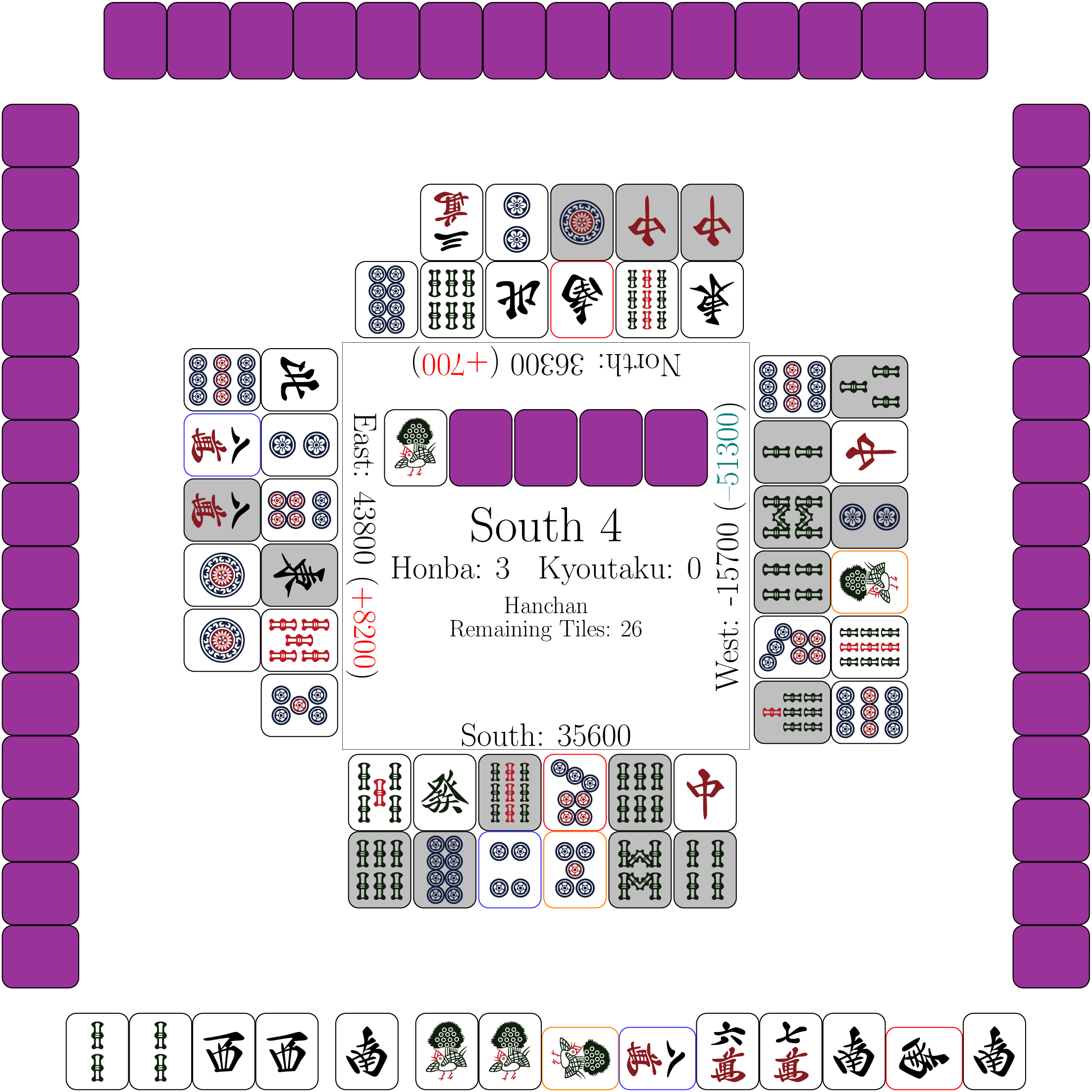
2z Pon -> 7p, 8m Chii -> 4p, 1s Pon -> 5p
I had to decide whether to kakan the 2z. Indeed, this was the decision that was plaguing my mind since I got into tenpai. Let’s discuss the various factors I was considering:
- First, my hand is a guaranteed mangan, winning it will result in 1st. However, my opponents don’t know that. If I elected to skip the kan, it might signal to them that I had a dora pair.
- The only player that has a strong reason to fold here is oya. If they don’t deal in, they are safely second, ensuring them getting into the semifinals. Indeed, they may already have folded against me, with the tedashi 1p pair.
- Going for the kan, I had a chance at a haneman with rinshan kaihou + 1 kandora or 2 kandora. Moreover, it gives me an extra draw when I’m in tenpai. I might be the only one in tenpai, so this extra dora is quite beneficial.
- I felt that NAGA will probably advocate for this kan, though I don’t know how NAGA deals with tobi scores. I knew afterwards my NAGA score will be made public, so maximising the NAGA score would be beneficial.
- I was playing on the streaming table, ending the round robin with a rinshan kaihou may indeed be quite exciting, no?
- Being realistic about my placement, in the case I do win this round, my overall tournament placement will be at best 1 place higher. I’ve checked that it was on average 4-5 points at the -50 to -70 range between players, so I don’t expect my placement to be much better from a haneman.
- I don’t know whether my last consideration is considered poor sportsmanship. But from my perspective, all three of the other Singaporean players have a decent shot in getting in the semifinals. There’s a chance that my kandora will open more dora (and uradora) for the oya, which in turn would lead to a more difficult life for my teammates if oya wins a bigger hand. For example, the difference between 4th and 5th in the semifinals was only 0.1 (100 points), so every point really matters.
You can see that in the situation, there was a mix of thoughts that are not entirely about the hand. I think such thoughts are inevitable when you play a recorded match, the perverse incentives come into play. I don’t know what the quote unquote correct decision would be, but I elected to skip the kan. Perhaps, I was just falling into omission bias, preferring inaction over action, when pressed to make a decision.
Overall the streaming table have been quite an experience. Getting to know the high-tech logistics that is behind was eye-opening. The setup definitely seems replicable, though would require a good reason and a decent amount of initial investment. Personally, it also made me a lot more comfortable playing in front of a camera. After one such session, you realise that there isn’t anything really scary (such as embarrassing yourself). Getting to experience it in a low-stakes environment is preferable to a rank-deciding match.
Costs
A key factor inescapable is the financial costs required to take part in an overseas tournament. If you are also planning to go on one, the following breakdown from this trip may prove helpful:
- Flights (300 SGD - 500 SGD)
- Hotel (60 SGD/night - 100 SGD/night)
- Transport and Food (200 SGD)
- Competition Fees (90 SGD)
Naturally, the exact details would vary on the location of the tournament. Hong Kong can also be considered a very close location to Singapore, only beaten by Indonesia, in terms of competition locations.
One could also attempt to save on money by sharing rooms with other competitors or reducing the cost of food. Going for overseas competition is not a cheap endeavour, and you should budget accordingly if you plan on going.
Some competitors in ACRC viewed it as an vacation to Hong Kong, with a few days set aside for mahjong. They stayed longer and explored the sights of Hong Kong. Perhaps, this amortises the cost of the trip.
Singapore’s Results
Going into day 2, Zhen Yao was in the middle of the cut for semifinals, while Feng and Travis are on the brink of falling out from semifinals cut. Meanwhile, I was near the bottom of the pack, from failing to secure a first in day 1. It was unlikely for me to make it to semifinals barring two runaway firsts, so I resolve to playing simply to maximise my eventual ranking and not aim for some improbable yakuman.
In the last two rounds, Feng and Travis faced some unfortunate rounds, ending their run. Only Zhen Yao managed to make semifinals.
| Player | Placing | Score |
|---|---|---|
| Zhen Yao | 15th | + 84.0 |
| Feng | 34th | - 5.9 |
| Travis | 37th | - 27.7 |
| Syx | 53rd | - 144.5 |
Out of the competition, we cheered on Zhen Yao into the semifinals, where he ended up placing 18th with a combined score of +20.8, earning a Bronze Medal.
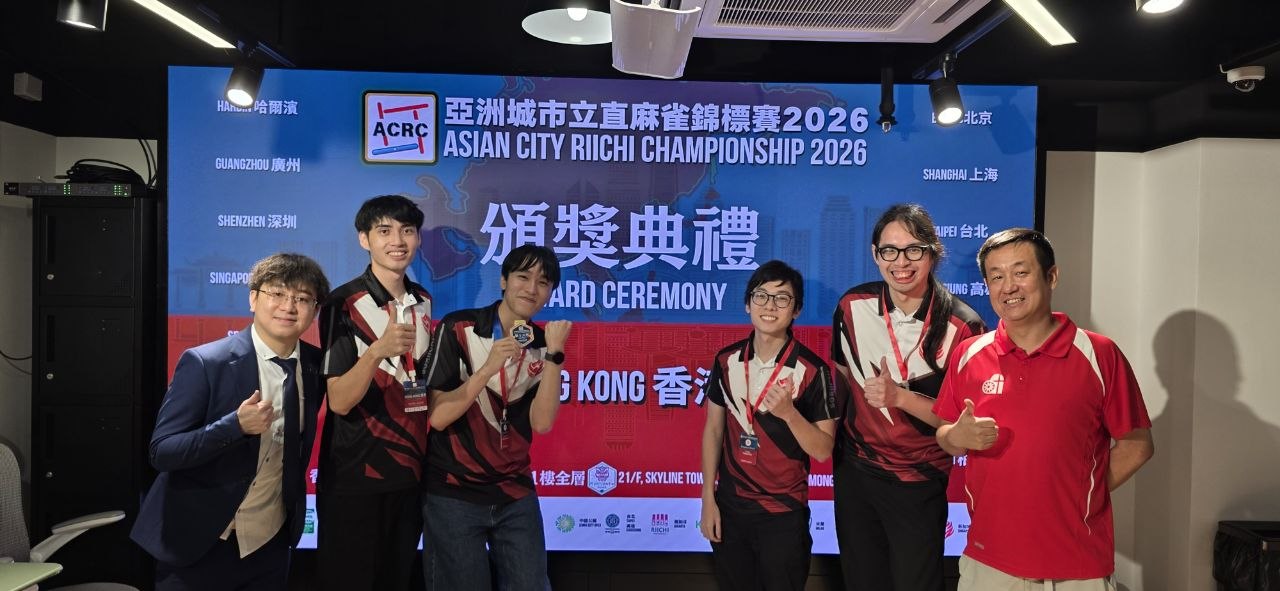
Left to Right: Lui Cheuk Yan (HKMA President), Travis, Zhen Yao, Feng, Syx, and 李文龙 (MIL Secretary-General)
Once again, we thank the organisers for extending an invitation to Singapore. Be it on the tournament circuit, or the next iteration of ACRC, I hope we will meet again.